May 23, 20246 min read
Jan 30, 20245 min read
Nov 23, 202310 min read

KL East is a district-scale exploration project covering approximately 20,000 hectares within the underexplored Blake River Group of the Abitibi Greenstone Belt.
The project is anchored by the Lucky Strike corridor, which hosts multiple zones of gold and copper mineralization along major regional structures interpreted to be continuations of the Kirkland Lake Main Break.
Historical work highlights widespread quartz veining, strong alteration, and documented gold mineralization across multiple targets. Despite these historical showings, the project remains underexplored, with significant opportunities for systematic follow-up. Multiple targets including Walsh, FP Zone, Copper King, and the McVittie intrusive remain open along strike and at depth, with strong potential for both structurally controlled gold and intrusion-related Au-Cu systems.
KL East represents a large, underexplored structural corridor with demonstrated mineralization and significant upside for new discoveries.
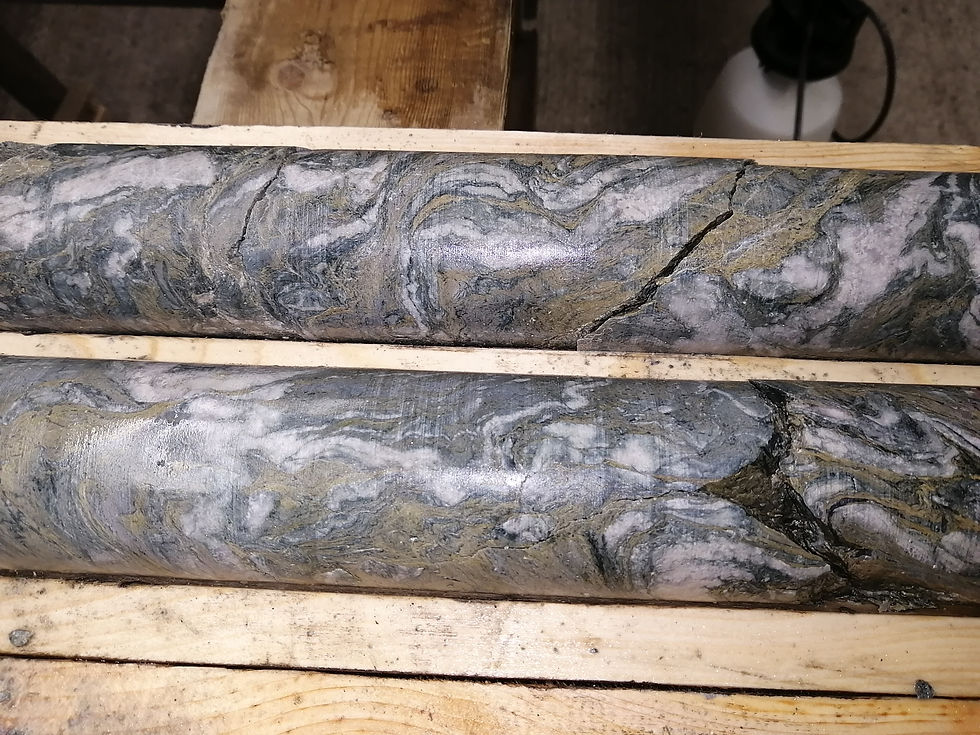
Photo: Mulven-Labrynthe LS22-LE01 around 58m-61m

100% KLDC
Abitibi Green Stone Belt, Ontario
Exploration
825 (including KL Bridge)
18,569ha (including KL Bridge)
18,569ha
The KL East project is hosted within the volcanic and intrusive rocks of the Blake River terrane in the Abitibi Greenstone Belt, located immediately north of the Upper Beaver Mine. The property is underlain by mafic to intermediate volcanic rocks of the Blake River Group, intruded by syenitic and dioritic bodies, forming a geologically diverse environment favorable for gold and copper mineralization.
On the property, mineralization is developed within a multi-phase magmatic-hydrothermal system and occurs as quartz vein systems and disseminated sulfides within altered host rocks. Sulfide assemblages are dominated by pyrite with variable chalcopyrite and minor sphalerite. Alteration is characterized by silicification, sericite, and locally potassic assemblages, reflecting evolving hydrothermal conditions and fluid-rock interaction.
Mineralization is spatially associated with lithological contacts, intrusive margins, and zones of deformation across the property. Two regional structures, the Misema–Mist Lake Fault and the Mulven–Kinabik Fault, transect the property and remain largely underexplored. These structures are interpreted to represent eastern extensions of the Kirkland Lake Fault (Main Break) system and act as primary conduits for fluid flow, providing favorable settings for gold and copper mineralization.
At the regional scale, the project lies within a continuous mineralized corridor defined by favorable stratigraphy, intrusive activity, and structural architecture. Historical work has identified mineralization across multiple areas of the property, including Walsh, FP Zone, Copper King, and the McVittie intrusive complex; however, the property remains underexplored at a systematic scale. The continuity of favorable geology and structure supports strong potential for additional mineralized zones along strike, at depth, and within parallel or structurally offset corridors across the broader property.