
TSX-V: KLDC OTC: KLKLF
KL SOUTH
Mirado Project
Located approximately 15 km south of the Company’s flagship claim package (Figure 1), the Mirado acquisition enhances the Company’s exploration pipeline while maintaining full commitment to advancing its high-priority targets within its core land position.
Figure 1: Updated property map including recent transaction to bring in the Mirado property which is now part of KL South.

Historical Mineral Resource and Technical Studies
Historical technical work at the Mirado Gold Project includes a Mineral Resource Estimate prepared by SRK Consulting in 2013 (report on Sedar+), which reported an inferred mineral resource of 10.6 Mt grading 1.29 g/t Au, containing approximately 442,000 oz Au. The estimate incorporated open-pit, underground, and stockpile material using cutoff grades of 0.45 g/t Au (open pit) and 2.0 g/t Au (underground and stockpiles). These mineral resource estimates are historical in nature and should not be relied upon. A Qualified Person has not completed sufficient work to classify them as current mineral resources.
A Preliminary Economic Assessment (PEA) completed in 2018 (effective January 8, 2018 report on Sedar+) evaluated a shallow open-pit scenario on the South Zone. The pit-constrained Mineral Resource Estimate reported:
-
559 kt Indicated grading 2.61 g/t Au (46.9 koz)
-
382 kt Inferred grading 2.66 g/t Au (32.7 koz)
Both classifications used a 1.0 g/t Au cut-off grade.
KLDC believes that additional drilling in currently open areas, both laterally and at depth, combined with updated geological interpretation and modern technical studies, has the potential to further define and expand mineralization. Any future mineral resource growth would be subject to additional drilling and completion of new National Instrument 43-101 compliant technical studies.
Table 1 - Comparison of 2013 Global Resource vs. 2018 Pit-Constrained Resource
Diamond drill hole GK19-022 from 246.94 m to 263.65m downhole (Jo Zone) illustrating intense deformation and alteration.

These estimates and economic results are historical in nature, and a Qualified Person has not completed sufficient work to classify them as current mineral resources. KLDC is not treating these historical estimates or economic results as current. The PEA is preliminary in nature, includes Inferred Mineral Resources that are considered too speculative geologically to have economic considerations applied, and there is no certainty that the results would be realized.
Geological Setting and Mineralization
Mirado lies south of the Larder Lake–Cadillac Break within the central Abitibi Greenstone Belt and is positioned between the felsic fragmental volcanic units of the Skead Assemblage and the ultramafic–mafic McElroy metavolcanics. Regional NW-trending faults along the Skead–McElroy contact provide primary structural control on mineralization (Figure 2).
Figure 2 – Plan View of KL South including the Mirado mine. Multiple high-grade gold showings at surface have limited drilling to test subsurface.

Gold mineralization at the Mirado deposit occurs within a hybrid orogenic–intrusion-related system comprised of disseminated and stockwork sulphide mineralization (Main Zone) and quartz–carbonate–sulphide vein systems (North Zone). Mineralization remains open at depth, with no deep drilling completed to date. An historical IP survey indicates that mineralization may continue at depth and remains untested (Figure 3).
Figure 3 – IP section through Mirado deposit looking northwest. Very limited drilling has occurred below 250 m with a historical IP survey indicating a potential extension of mineralization at depth.
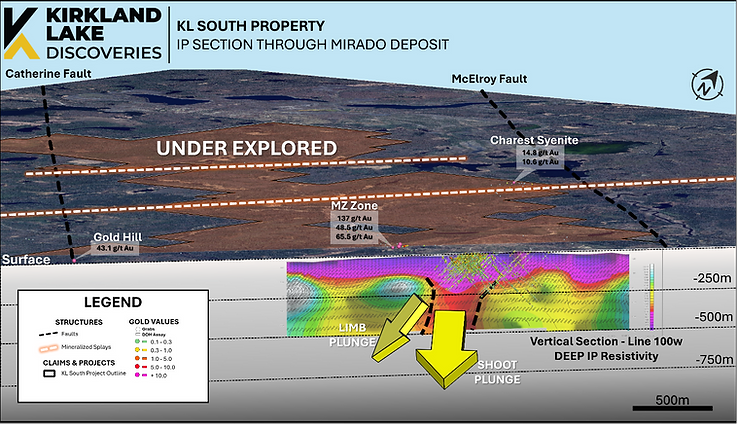
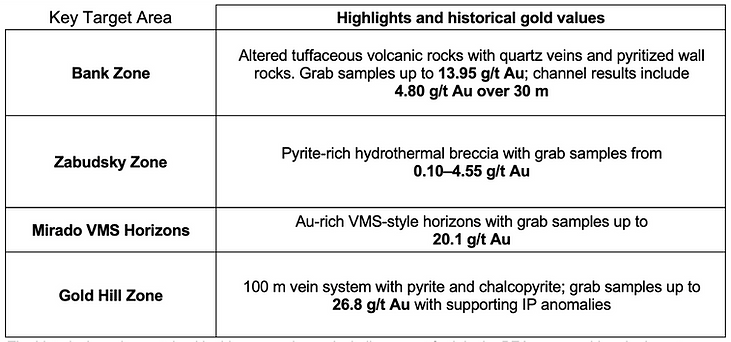
Table 2 -Mirado Project Key Target Areas – with historical gold values
The historical results contained in this press release, including as set forth in the PEA, are considered relevant as they indicate the presence of gold mineralization and assist in guiding exploration targeting. No field testing of samples has been completed to confirm mineralization.